Swollen Lymph Nodes: How Long Is Normal and When to Get Checked
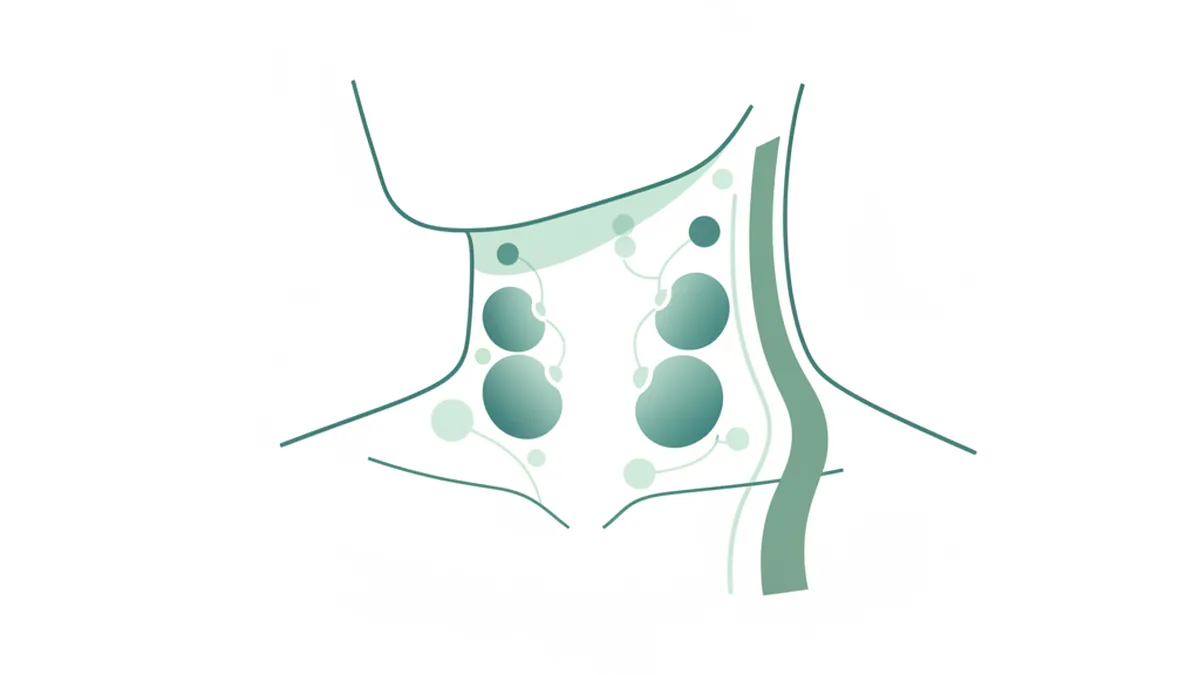
You're running your fingers along your neck and there it is — a small, firm lump that wasn't there last week. Or maybe it was, and you just noticed it. Either way, now you're acutely aware of this thing under your skin, and suddenly every swallow feels different.
Most swollen lymph nodes aren't cause for alarm. Your lymph system is working exactly as designed, filtering out bacteria and viruses like a biological security checkpoint. But that explanation doesn't entirely settle the question keeping you up at night: how long should this last, and at what point does "normal immune response" become "something I should get checked"?
The answer depends on several factors that matter more than a strict timeline.
Why does this happen?
Your body contains roughly 600 lymph nodes, though you can only feel about 20 of them when they swell — primarily in your neck, armpits, and groin. These bean-shaped structures act as filtering stations where immune cells encounter and destroy pathogens. When your immune system ramps up activity in response to infection, inflammation, or other triggers, the nodes can enlarge from their normal pea-size to anywhere from grape to walnut dimensions.
The most common culprit? Upper respiratory infections. A cold, flu, strep throat, or even an infected tooth can cause the nodes in your neck to swell as they work overtime processing the bacterial or viral load. This is textbook immune function. The nodes nearest the infection site typically enlarge first and most noticeably.
But infections aren't the only trigger. Immune conditions, certain medications, and yes, occasionally more serious issues can all cause lymph node enlargement. The characteristics of the swelling — its duration, texture, location, and accompanying symptoms — help distinguish between these possibilities.
Most people find that lymph nodes related to common infections feel somewhat tender, move slightly when pressed, and have a rubbery rather than rock-hard texture. They typically appear on both sides of the body, though one side may be more prominent. The surrounding skin looks normal, without redness or warmth.
Here's what many people don't realize: lymph nodes often lag behind the actual infection. You might feel completely recovered from your cold while those neck lumps persist for weeks. This delay can be unnerving, but it reflects normal immune timing rather than ongoing infection.
Is this serious?

Most swollen lymph nodes resolve within two to four weeks, though some take six weeks or occasionally longer. Research shows that the majority of lymph node swelling in otherwise healthy adults stems from benign causes, with the percentage of serious underlying conditions relatively small in the general population.
That said, certain features warrant immediate attention. Size matters, but context matters more. A marble-sized node that appeared overnight during an active sinus infection carries different weight than a golf ball-sized mass that developed slowly over months with no clear trigger.
Doctors get concerned when nodes display specific warning characteristics:
Texture and mobility: Hard, immovable nodes fixed to surrounding tissue raise more concern than softer, mobile ones. If you can't shift the lump even slightly when you press on it, that's worth checking. Very firm nodes that feel rock-like or irregular rather than smoothly rounded also merit evaluation.
Progressive growth: A node that continues enlarging steadily beyond four weeks, especially without clear infectious cause, needs investigation. Growth that doesn't slow or reverse suggests something beyond temporary immune activation.
Location patterns: Nodes above the collarbone (in the supraclavicular area) have higher rates of serious underlying causes than neck or armpit nodes. Multiple swollen node areas throughout the body — neck, armpits, and groin all involved simultaneously — can indicate systemic rather than localized issues.
Accompanying symptoms: Drenching night sweats that soak your sheets, unintentional weight loss of more than 10 pounds over several months, or persistent fevers without clear infection all warrant prompt evaluation. These "B symptoms," as clinicians call them, can indicate conditions requiring diagnosis and treatment.
Skin changes: Redness, warmth, or visible swelling in the skin over the node might indicate infection within the node itself — a condition called lymphadenitis that sometimes requires antibiotics.
Age and health history also factor into the assessment. Someone over 40 with new, unexplained lymph node swelling and someone with a history of cancer face different risk calculations than a twenty-something with a cold and swollen neck nodes.
The hardest scenarios involve nodes that persist just beyond the typical timeline but lack clear danger signs. You're six weeks out from your last cold, the nodes have shrunk but not disappeared, you feel fine otherwise, and you're wondering whether to push for imaging or keep waiting. These gray zones require individualized judgment, ideally with a clinician who can examine you directly.
What should I do?

Start by mapping what you're experiencing. When did you first notice the swelling? Has it grown, shrunk, or stayed constant? Can you connect it to a recent illness, dental work, or even a scratch or bite near the area? These details help distinguish normal immune response from situations requiring investigation.
For nodes that appeared during or shortly after an infection, watchful waiting with measurement makes sense for most people. Note the size and track changes over several weeks. A node that peaks and then gradually shrinks follows the expected pattern. Use your fingertips to check size rather than relying on how it feels — anxiety can make nodes seem larger than they are.
Address any active infections properly. Complete your full antibiotic course if prescribed (don't stop early when symptoms improve), treat strep throat, deal with that abscessed tooth. Sometimes nodes persist simply because the underlying trigger hasn't fully resolved.
Avoid repeatedly poking and prodding. Yes, checking occasionally helps you track changes, but constant examination won't speed healing and can actually perpetuate swelling through mechanical irritation. Twice daily checks suffice.
Seek evaluation if:
- A node exceeds roughly half an inch and remains that size beyond four to six weeks with no infection history
- Any node continues growing steadily beyond two weeks
- The node feels very hard or completely immobile
- You develop night sweats, unexplained fever, or unintentional weight loss
- Nodes appear in multiple body areas simultaneously
- The skin over the node becomes red, warm, or tender
- You notice nodes above your collarbone
- You have difficulty swallowing, breathing, or your voice changes
- You're over 40 with new, unexplained node swelling
Don't wait if you experience throat tightness, difficulty breathing, or rapid node enlargement that seems to develop over hours rather than days. Those situations warrant emergency evaluation.
How to tell lymph node swelling apart from other lumps
Not every bump under your skin is a lymph node, and the confusion can send you down some anxious mental paths. Learning to distinguish lymph nodes from other common lumps helps you assess what you're actually dealing with.
Lymph nodes sit in predictable clusters. Run your fingers along the sides of your neck, from just below your ear down toward your collarbone — that's prime lymph node territory. The hollow above your collarbone, your armpits, and your groin also house accessible nodes. If you find a lump on your shin, the back of your hand, or the top of your shoulder, it's probably not a lymph node. Location alone narrows the possibilities considerably.
Lipomas — benign fatty tumors — feel softer and more doughy than lymph nodes. They move freely under the skin when you press them, almost like a water balloon, and they typically grow very slowly over months or years. A lipoma on your upper back or shoulder might feel superficial, just under the skin surface, while lymph nodes sit deeper in tissue. Lipomas don't appear suddenly during an infection and don't shrink on their own.
Cysts, particularly sebaceous or epidermoid cysts, often have a visible central pore or punctum — a tiny dark dot where the cyst connects to the skin surface. They can feel firm and round like a node, but they're usually more superficial and may become red and tender if infected. Unlike reactive lymph nodes, cysts don't correlate with your recent cold or sore throat. They just sit there, sometimes for years, occasionally getting inflamed.
Muscle knots in your neck or shoulder can masquerade as swollen nodes, especially if you've been stressed or sleeping in awkward positions. These feel ropy or band-like rather than distinctly round, and they often hurt more when you move your neck or press deeply into the muscle. A true lymph node feels more discrete — a defined oval or bean shape you can isolate with your fingertips.
Thyroid nodules sit front and center in your lower neck, moving up and down when you swallow. Lymph nodes in your neck stay put when you swallow. If you're feeling something that rides up with your Adam's apple, that's thyroid territory, not lymph.
Here's a practical test: swollen reactive lymph nodes from infection often appear on both sides of your neck, though one side may be larger. If you find a single isolated lump that's been there for months without any matching lump on the other side and no history of recent illness, it's less likely to be a reactive node. Symmetry isn't a hard rule — infections can cause asymmetric swelling — but bilateral involvement points more clearly toward lymph node response.
When you press on a reactive lymph node, it may feel mildly tender, like a bruise. Lipomas typically don't hurt. Inflamed cysts can be quite painful. Muscle knots ache in a different way, often radiating discomfort into surrounding areas when you apply pressure. The quality of tenderness gives you information.
If you're genuinely unsure what you're feeling, a healthcare provider can usually tell within seconds of examination. They've palpated thousands of lumps and bumps and know the textural signatures. Don't spend weeks in uncertainty trying to self-diagnose from internet descriptions. A quick exam settles the question and either reassures you or gets you on the right diagnostic path.
What to track and what to tell your doctor
If you decide to monitor swollen nodes before seeking evaluation — or if your doctor recommends watchful waiting — tracking the right details makes follow-up conversations far more productive. Vague reports like "it's still there" don't give a clinician much to work with. Specific observations do.
Measure, don't just feel. Your perception of size can shift with anxiety. What felt enormous last Tuesday might feel the same this Tuesday, but your worry has amplified. Use a tape measure or compare the node to common objects — pea, grape, walnut — and note the size every three to four days. Write it down. A node that measured three-quarters of an inch two weeks ago and measures half an inch today is shrinking, even if it still feels prominent to you. That trajectory matters more than absolute size at any single point.
Track the timeline precisely. "A few weeks ago" becomes "five and a half weeks" when you check your calendar. Note the date you first noticed the swelling and the date of any infection or trigger that preceded it. If you saw a doctor, record when. If you started antibiotics, note the start and end dates. This timeline helps distinguish normal delayed resolution from true persistence.
Document associated symptoms — or their absence. Are you having night sweats? Not just feeling warm under heavy blankets, but waking up drenched enough to change your shirt? Have you lost weight without trying? How much, over what period? Any fevers you can measure with a thermometer? Fatigue that's more than just end-of-day tiredness — the kind that makes climbing stairs feel like a workout? These systemic symptoms change the clinical picture significantly. But their absence is also useful information. "No fever, no weight loss, no night sweats, energy normal" tells a doctor this looks localized.
Note what makes it better or worse. Does the node swell more after you eat, or when you're tired, or during your menstrual cycle? Does it shrink after you take ibuprofen? Some patterns point toward inflammation; others suggest different mechanisms. Even "nothing changes it" is a data point.
Photograph it if visible. A lump in your neck that's large enough to see externally can be photographed from the same angle every few days. Visual documentation removes memory bias. You'll know for certain whether it's actually growing or your anxiety is growing.
When you do speak with a healthcare provider, lead with the facts you've gathered. "I first noticed a firm, mobile lump on the right side of my neck six weeks ago, three days after I finished antibiotics for strep throat. It was about grape-sized at its largest, two weeks in. Now it's closer to a large pea. It's mildly tender when I press it. No fever, no night sweats, no weight loss. I feel completely well otherwise." That narrative gives a clinician a clear picture and demonstrates you've been tracking appropriately.
Avoid the temptation to self-diagnose and then argue for that diagnosis. Don't walk in saying "I'm sure this is just reactive from my cold, right?" or "I think I need a biopsy immediately." Present your observations and let the clinician integrate them with their exam findings. You're the expert on your own body's timeline and symptoms; they're the expert on interpreting those findings in context.
If your doctor recommends continued monitoring rather than immediate testing, ask what specific changes should prompt you to return. "Come back if it's not better in a month" is vague. "Return if the node exceeds one inch, becomes hard and immobile, or if you develop fevers or night sweats" gives you clear criteria. Don't leave the appointment without understanding your re-evaluation threshold.
Most of the time, your tracking will show gradual improvement — the node shrinking week by week until you forget to check it and realize one day it's gone. That's the usual story. But if your log shows growth, new symptoms, or plateau without improvement beyond six weeks, you've got the documentation to justify next steps. Either way, you've replaced anxious uncertainty with informed monitoring.
When you do see a healthcare provider, they'll likely start with a physical exam and health history. They're looking for node characteristics, checking for patterns (localized versus widespread), examining your throat and tonsils, feeling for organ enlargement in your abdomen, and assessing your general health. Blood work can reveal signs of infection or immune activity. Based on those findings, they might recommend watchful monitoring, antibiotics if infection seems likely, or further testing like ultrasound or biopsy for concerning features.
Many people worry that requesting evaluation means they're overreacting or wasting medical time. Here's the reality: clinicians would rather examine benign reactive nodes than miss something in its early stages. If your nodes meet the concerning criteria above, getting checked is appropriate self-advocacy, not hypochondria.
The anxiety around swollen lymph nodes often exceeds the actual danger, but that anxiety itself has a purpose — it prompts you to pay attention and seek care when truly needed. Trust the timeline and warning signs. Most nodes quiet down within several weeks as your immune system completes its work. The ones that don't follow that pattern, or that display the red flags above, deserve professional evaluation.
You know your body. If something feels distinctly wrong beyond the expected recovery timeline, or if the node shows worrying characteristics, pursue evaluation. But if you're three weeks past a respiratory infection with slowly shrinking neck nodes and no other symptoms, patience usually proves the right call. The key is distinguishing between the two scenarios with clear-eyed assessment rather than catastrophic thinking.
This article is for informational purposes only and isn't a substitute for medical advice. Talk to a qualified healthcare provider about your specific situation.
Sources & further reading
This article draws on guidance from recognized health authorities:


Comments
Post a Comment