Intermittent Fasting: What the Evidence Actually Shows
Myth: Intermittent fasting is a miracle weight-loss solution that works for everyone.
Reality: It's a meal-timing strategy that helps some people eat less — and the metabolic benefits beyond weight loss are still being debated.
Here's what nobody tells you about intermittent fasting when you're scrolling through transformation photos: most people quit within three months. Not because it doesn't work, but because the version they're attempting doesn't match their actual life.
The internet sells intermittent fasting as revolutionary. It's not. Humans have always gone periods without eating — sometimes by choice, often by circumstance. What's changed is our 24-hour access to food and our expectation that any eating pattern should feel effortless from day one.
Let's separate what we know from what we're still figuring out.
The Fasting-Fixes-Everything Fantasy
The most pervasive myth positions intermittent fasting as a metabolic reset button that burns fat faster, reverses insulin resistance, triggers cellular cleanup (autophagy), and extends lifespan. Social media amplifies this with before-and-after photos and testimonials that sound almost religious in their conviction.
This narrative has some threads of truth woven into a lot of speculation.
Research does show that restricting your eating window can lead to weight loss — but here's the catch most influencers skip: it works primarily because it's hard to overeat when you're only eating for eight hours. A 2020 review in the New England Journal of Medicine noted that time-restricted eating often reduces total calorie intake by 300-500 calories daily, simply because people skip a meal or cut out late-night snacking.
The autophagy claim? That's where things get murky. Autophagy — the cellular "housekeeping" process where your body breaks down and recycles damaged components — does increase during fasting in animal studies. But we don't have solid human data showing that a 16-hour overnight fast triggers clinically meaningful autophagy. Most autophagy research uses multi-day fasts or severe calorie restriction in mice. Extending that to "skipping breakfast activates autophagy" is a stretch the science doesn't support yet.
Lifespan extension faces the same problem. Calorie restriction extends life in yeast, worms, and some rodents. Whether that translates to humans eating in an eight-hour window? We won't know for decades. Anyone selling intermittent fasting as a longevity tool is selling a hypothesis, not evidence.
Why the Myth Persists (And Why It's Appealing)

Intermittent fasting offers something deeply attractive: simplicity. Instead of tracking macros, counting calories, or avoiding entire food groups, you just watch the clock. Eat between noon and 8 PM. Done.
That clarity is powerful, especially in a nutrition landscape drowning in contradictions. Keto says avoid carbs. Paleo says avoid grains. Whole30 says avoid everything fun. Intermittent fasting says eat whatever you want, just not whenever you want.
The other reason it sticks? It works for enough people to generate genuine testimonials. Someone who previously ate from 7 AM to 11 PM now eats from noon to 8 PM. They've eliminated breakfast (maybe 400 calories) and late-night snacking (another 300). They lose 10 pounds in two months. They credit the fasting. Technically, they're correct — the fasting window created the calorie deficit. But it's not magic. It's structure.
The myth persists because the reality is less exciting: "This is one of several ways to eat less, and whether it's sustainable depends entirely on your schedule, hunger patterns, and relationship with food."
What the Research Actually Shows
Here's where we stand based on the current evidence:
Weight loss happens, but it's not superior to regular calorie restriction. Multiple studies comparing time-restricted eating to standard calorie counting find similar weight loss after six months. A 2022 study in the New England Journal of Medicine randomized over 100 people with obesity to either 16:8 fasting or unrestricted eating times (both groups targeted the same calorie deficit). The weight loss? Nearly identical. The fasting group lost about 8 kg; the continuous restriction group lost 6.3 kg — not a statistically significant difference.
It might improve insulin sensitivity — but weight loss alone does that too. Some research suggests time-restricted eating improves how your body responds to insulin independent of weight loss. A small 2018 study found that men with prediabetes who ate only between 8 AM and 2 PM (a 6-hour window) improved their insulin response even without losing weight. But other studies haven't replicated this when eating windows fall later in the day. The timing might matter more than we thought.
Adherence is terrible. This is the real story. In most studies, 30-40% of participants drop out before the trial ends. Real-world adherence is likely worse. The controlled environment of a research study — with regular check-ins and support — is nothing like maintaining a fasting schedule during business travel, family dinners, or stressful work periods.
Hunger doesn't always adapt. The promise is that your body adjusts and you stop feeling hungry in the morning. For some people, yes. For others, the morning hunger never fades, and they spend 16 hours daily in a low-grade state of irritability and distraction. Ghrelin, your hunger hormone, does shift its peak secretion times after several weeks of consistent meal timing, but individual variation is huge. Some people's biology resists the change.
Athletic performance can suffer — or stay the same. Endurance athletes often adapt well to fasted training for moderate-intensity work. But high-intensity interval training, heavy strength work, or sports requiring explosive power? Studies show performance declines when glycogen stores are depleted. If you're trying to build muscle or improve your 5K time, eating before training likely serves you better than fasting.
The picture isn't as clean as "intermittent fasting works" or "it doesn't." It works for weight loss if it helps you eat less. Whether it offers metabolic benefits beyond calorie restriction is still genuinely uncertain.
What to Actually Do
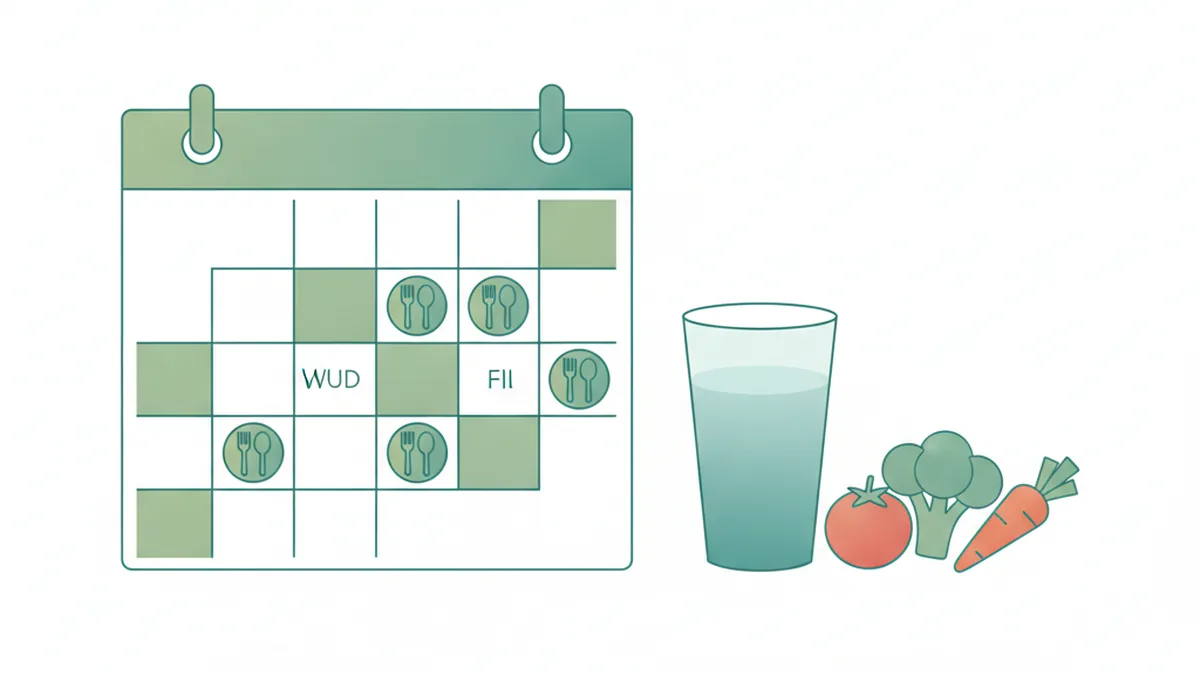
If you're considering intermittent fasting, here's a more honest framework:
Try it as a scheduling tool, not a miracle cure. If your current eating pattern includes mindless grazing from dinner until bedtime, setting a hard stop at 8 PM might help. You're not activating ancient metabolic pathways. You're creating a boundary.
Match the window to your life, not the other way around. The 16:8 pattern is popular because it fits a lot of schedules — skip breakfast, eat lunch through early dinner. But if you train at 6 AM and feel wrecked without food, try 12:8 (12-hour fast, 12-hour eating window) instead. The research doesn't show that 16 hours is magic compared to 14 hours.
Give it four weeks before deciding. The first week is rough for most people. Hunger peaks, energy dips, irritability surfaces. Your body is adjusting its hunger hormone rhythms. By week three or four, you'll know if this is sustainable or misery. If you're still fighting it after a month, it's probably not your pattern.
Don't use the eating window as permission to binge. The psychological trap: "I can eat anything between noon and 8 PM!" followed by 3,000 calories of high-reward food because "I'm fasting 16 hours, so this balances out." It doesn't. If you consistently overeat during your window, you won't lose weight. Time-restricted eating isn't a metabolic loophole.
Watch for warning signs. If fasting triggers obsessive thoughts about food, binge eating during your window, increasing anxiety around meal times, or if you have a history of disordered eating — stop. The structure that helps one person can harm another. This isn't weakness; it's biology and psychology intersecting in ways that matter.
Consider your medical context. If you're managing diabetes with medication, fasting changes when you need to dose insulin or other drugs. That requires coordination with your healthcare provider, not a YouTube tutorial. People with a history of eating disorders should approach any structured eating pattern cautiously. Pregnant or breastfeeding? Fasting isn't appropriate — your energy needs don't pause for 16 hours.
The Real Test: One Month In
Here's how you'll know if intermittent fasting is working for you:
You feel basically normal during fasting hours. Not ecstatic, not deprived. Just normal. Maybe slightly hungry before your first meal, but not shaky or unable to concentrate.
You're eating roughly the same foods you ate before, just in a compressed window. If you've completely overhauled your diet at the same time, you won't know which change is doing what.
You're losing weight at a reasonable rate if that's your goal — roughly 0.5-1 kg per week. Faster than that and you're likely undereating. Not losing? You're eating at maintenance despite the restricted window.
Your energy during workouts is stable or improving as you adapt. If your strength is dropping or your runs feel progressively harder after four weeks, the fasting window might be limiting your performance.
You can imagine doing this for six months without feeling resentful. That's the real test. Not "can I white-knuckle through this," but "does this feel sustainable?"
When to Talk to a Doctor
Intermittent fasting sounds simple — just skip breakfast — but it can complicate existing conditions. Worth discussing with a healthcare provider if:
- You take medication that requires food (especially diabetes medications, certain antibiotics, or NSAIDs)
- You have a history of disordered eating or are in recovery from an eating disorder
- You're experiencing persistent fatigue, dizziness, or difficulty concentrating during fasting hours
- Your menstrual cycle becomes irregular (some women's hormones don't tolerate prolonged fasting well)
- You have existing metabolic conditions like diabetes or metabolic syndrome — fasting can help, but it needs medical oversight
And obviously: if you're losing weight too rapidly, developing obsessive food thoughts, or feeling worse rather than better after a month, stop and reassess with professional guidance.
The Honest Bottom Line
Intermittent fasting isn't a metabolic revolution. It's a meal-timing pattern that makes it easier for some people to eat less. The weight loss is real when it happens, but it's driven by calorie reduction, not cellular magic.
The metabolic benefits beyond weight loss? Possible. Promising in some animal research. Uncertain in humans. We need longer, larger trials before claiming it reverses aging or prevents disease independent of weight loss.
But here's what it absolutely does offer: structure. For people who do well with clear boundaries, who struggle with evening snacking, or who find calorie counting tedious, time-restricted eating provides a simple rule. Eat during this window. Don't eat outside it. For the right person, that clarity is valuable.
Just don't expect it to work effortlessly, permanently, or universally. If it fits your life after an honest month-long trial, use it. If it doesn't — if you're fighting hunger all day or your performance is suffering — you're not broken. You just need a different approach.
The best eating pattern is the one you can maintain without suffering. Sometimes that's 16:8. Often it's not. Both are fine.
This article is for informational purposes only and isn't a substitute for medical advice. Talk to a qualified healthcare provider about your specific situation.
Sources & further reading
This article draws on guidance from recognized health authorities:


Comments
Post a Comment